
Hail Damage Roof Guide: Storm Signs to Watch
After a storm rolls through, the last thing you want is hidden roof damage silently destroying your home. The problem is that most storm damage is not visible from the ground. Hail bruises shingles without breaking them. Wind lifts edges that reseal themselves flat. Rain exploits cracks you cannot see. By the time a leak appears inside your home, the damage has been spreading for weeks or months. This guide teaches you exactly what hail damage looks like on a roof, how to tell if your roof has storm damage, and when to call a certified inspector for a professional assessment.
Need a certified storm damage roof inspection? Request an appointment with Cert-A-Roof before hidden damage becomes a leak.
Key Takeaways: Storm and hail damage often hides in plain sight. Knowing what to look for on each roofing material, checking safely from the ground, and getting a certified inspection after any major storm are the best ways to protect your home and your insurance claim.
- Hail damage looks different on asphalt shingles, tile, metal, and flat roofs
- Wind damage and hail damage require different repair approaches
- A safe ground-level check can reveal early warning signs
- Hidden damage causes more long-term problems than obvious damage
- A certified roof inspection creates documentation that strengthens insurance claims
- Both Southern California storms and Montana hailstorms cause significant roof damage
What Does Hail Damage Look Like on a Roof?
Hail damage varies dramatically depending on your roofing material. A dent on a metal roof looks nothing like granule loss on an asphalt shingle. Understanding what to look for on your specific roof type is the first step toward catching damage before it causes leaks.
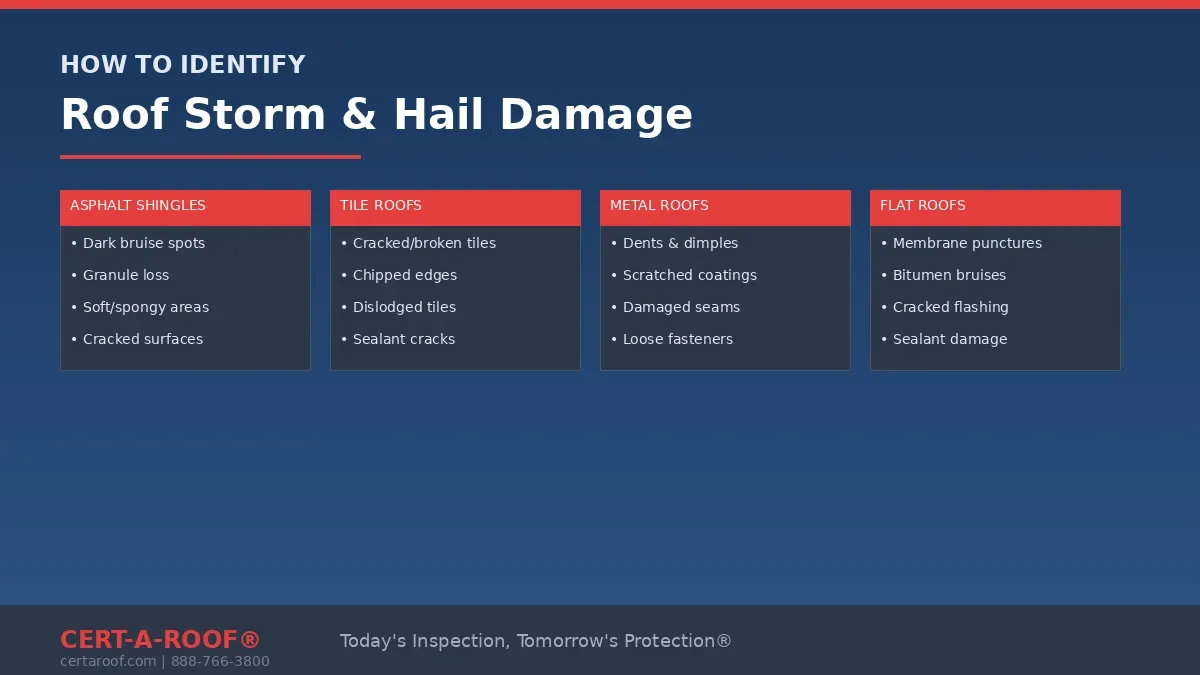
Asphalt Shingle Roofs
Asphalt shingles are the most common roofing material in the United States, and they are also the most vulnerable to hail. Here is what to look for:
- Random dark spots or bruises. Hail impacts knock off the protective granules that coat the shingle surface. These bare spots appear as dark circles or irregular patches, typically ranging from the size of a dime to a quarter. The exposed asphalt underneath degrades quickly in sunlight.
- Soft spots when pressed. If you can safely touch a damaged shingle, it may feel spongy or soft at the impact point. This means the fiberglass mat beneath the granules has fractured, and the shingle’s structural integrity is compromised.
- Granules collecting in gutters. After a hailstorm, check your gutters and downspout outlets. Excessive granule accumulation (small, sand-like particles) is one of the clearest signs of widespread hail damage, even when individual shingle bruises are hard to see from the ground.
- Cracked or fractured shingles. Larger hailstones, generally one inch or bigger, can crack shingles outright. These cracks create direct pathways for water to reach the underlayment and roof deck.
Tile Roofs
Concrete and clay tile roofs are common across Southern California. Tile is more resistant to hail than asphalt, but it is not immune:
- Cracked or broken tiles. Hail impacts can crack tiles, especially clay tiles that are more brittle. Even hairline cracks allow water infiltration over time.
- Chipped edges and corners. The edges and corners of tiles are their weakest points. Hailstones often chip these areas first.
- Dislodged tiles. The combination of wind and hail can shift tiles out of position, breaking the interlocking pattern that keeps water out.
- Damage to tile sealant. The mortar or sealant at tile joints can crack from hail impacts, creating water entry points that are invisible from the ground.
Metal Roofs
Metal roofing is increasingly popular for both residential and commercial properties. Hail damage on metal looks different from other materials:
- Dents and dimples. Hailstones leave visible dents on metal panels and standing seam roofs. While small cosmetic dents may not affect function, larger dents can compromise the panel’s ability to shed water.
- Scratched or gouged coatings. Metal roofs rely on protective coatings (paint, zinc, or aluminum) to resist corrosion. Hail can scratch through these coatings, exposing bare metal to rust.
- Damaged seams and fasteners. The joints between metal panels and the fasteners holding them down are vulnerable to hail. Damaged seams can allow wind-driven rain to enter.
Flat and Low-Slope Roofs
Commercial buildings and some residential properties in Southern California use flat or low-slope roofing systems (TPO, EPDM, modified bitumen, or built-up roofing). Hail damage on these systems includes:
- Punctures in the membrane. Large hailstones can puncture single-ply membranes, creating immediate leak points.
- Bruises on modified bitumen. Similar to asphalt shingles, the surface granules on modified bitumen can be displaced by hail.
- Cracked flashing and edge details. The metal flashing at edges, drains, and penetrations on flat roofs is vulnerable to hail dents and displacement.
- Compromised sealants. Hail impacts can crack the sealant around vents, pipes, and HVAC curbs on flat roofs.
Wind Damage vs. Hail Damage vs. Rain Damage
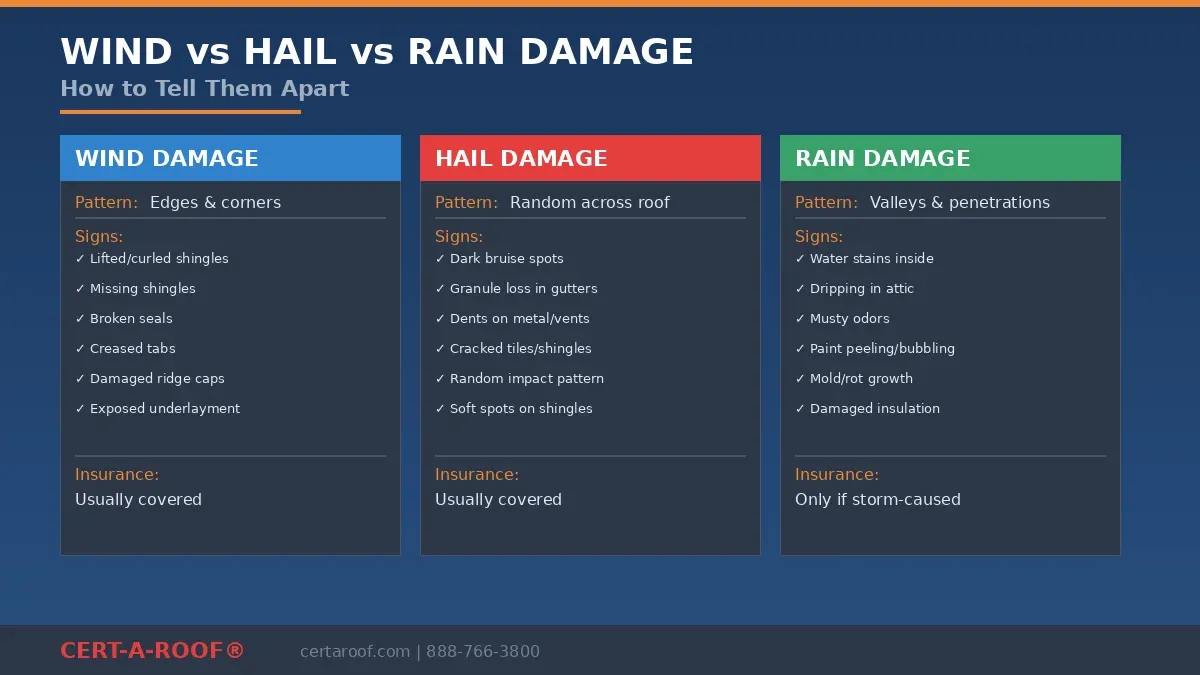
Storms rarely bring just one type of weather. High winds, hail, and heavy rain often arrive together, and each causes distinct types of roof damage. Telling them apart matters because it affects your repair strategy and your insurance claim.
| Damage Type | What It Looks Like | Common Location | Insurance Coverage |
|---|---|---|---|
| Wind Damage | Lifted, curled, or missing shingles; broken seals; exposed underlayment | Roof edges, ridges, corners (most wind-exposed areas) | Usually covered as sudden/accidental |
| Hail Damage | Bruises, granule loss, dents, cracks; random pattern across the roof | Entire roof surface, vents, gutters, flashing | Usually covered as sudden/accidental |
| Rain Damage | Water stains, mold, rot; damage concentrated at penetrations and valleys | Valleys, flashings, pipe boots, chimney surrounds | Covered only if caused by a covered event (storm, not wear) |
How Wind Damages Your Roof
Wind does not affect your roof evenly. The edges, corners, and ridgeline experience significantly more uplift force than the center of the roof. This is why wind damage typically shows a pattern: the most severe damage along edges and corners, with less impact toward the center.
Common signs of wind damage include:
- Lifted or curled shingle tabs. Wind gets under shingle edges and breaks the adhesive seal. The shingle may lay back down after the wind stops, hiding the damage.
- Missing shingles. Strong gusts can tear shingles completely off the roof, leaving exposed underlayment or roof deck.
- Creased shingles. Wind flexes shingles back and forth, creating permanent creases that weaken the material.
- Damaged ridge caps. The ridge cap shingles along the peak of your roof are the most exposed to wind and are often the first to fail.
How Rain Exploits Existing Damage
Rain itself rarely damages a properly maintained roof. Instead, rain reveals and worsens damage caused by wind and hail. Once wind lifts a shingle or hail cracks a tile, rain water follows the path of least resistance through the opening and into your home.
Watch for these signs after a rainstorm:
- New water stains on ceilings or walls that were not there before the storm
- Dripping in the attic near roof penetrations (vents, pipes, chimneys)
- Musty odors indicating moisture accumulation
- Paint peeling or bubbling on interior walls near the roofline
How to Check Your Roof After a Storm (Safe DIY Exterior Check)
You do not need to climb on your roof to check for storm damage. In fact, walking on a damaged roof can be dangerous and can cause additional damage. A thorough ground-level inspection can reveal many warning signs.
Step 1: Wait for Safe Conditions
Do not inspect your property during the storm or immediately after if there is lightning, high winds, or downed power lines nearby. Wait until conditions are safe and the roof surface is dry enough that debris is visible.
Step 2: Walk the Perimeter of Your Home
Start by walking around your entire home and looking up at the roof from each side. Look for:
- Missing or displaced shingles/tiles. These may be visible from ground level, especially along roof edges.
- Debris on the roof. Fallen branches, leaves, or other items that could be concealing damage underneath.
- Damaged ridge caps or vents. Metal roof vents and ridge caps are easy to spot from the ground and are often the first components damaged by hail.
Step 3: Check the Gutters and Downspouts
Your gutter system collects evidence of roof damage. After a storm, look for:
- Excessive granules. A normal amount of granule washoff is expected, but large accumulations after a storm indicate hail damage to asphalt shingles.
- Dents in metal gutters. If your aluminum gutters show hail dents, your roof almost certainly does too.
- Debris and blockages. Broken shingle pieces, tile fragments, or torn flashing in your gutters signal roof damage.
Step 4: Inspect Siding, Windows, and Outdoor Equipment
Hail does not just hit your roof. Check for:
- Dents on air conditioning units, mailboxes, or car hoods. These confirm that hail was large enough to cause roof damage.
- Cracked or chipped window screens. Hail damage to window screens is a strong indicator of roof damage.
- Dents or marks on wood decks, fences, or painted surfaces. These show the size and force of the hailstones that hit your property.
Step 5: Look Inside Your Home
Go into your attic if you have access and use a flashlight to check for:
- Daylight showing through the roof deck. Any light visible through the roof boards means there are gaps or holes.
- New water stains or damp spots. Check rafters, sheathing, and insulation for moisture.
- Musty smells. Fresh moisture in an attic produces a noticeable odor quickly.
Signs of Hidden Storm Damage You Might Miss
The most expensive storm damage is the damage you do not catch early. These hidden issues can go undetected for months while slowly causing structural problems, mold growth, and water damage.
Broken Shingle Seals (Wind)
Asphalt shingles are held in place by a thermally activated adhesive strip. Wind can break this seal without tearing or moving the shingle. The shingle looks normal from the ground, but the broken seal allows wind-driven rain to get underneath. This is one of the most common forms of hidden storm damage, and it requires a hands-on inspection to detect.
Granule Loss Without Visible Cracks (Hail)
Hail can knock granules off shingles without cracking them. The shingle appears intact from a distance, but the exposed asphalt ages rapidly under UV exposure. Within 6 to 12 months, the affected areas become brittle and begin to crack and curl. By then, the damage has spread far beyond the original hail impacts.
Micro-Fractures in Tile (Hail)
Concrete and clay tiles can develop micro-fractures from hail impacts that are invisible to the naked eye. These hairline cracks allow moisture to penetrate the tile, and freeze-thaw cycles in Montana or temperature fluctuations in Southern California widen them over time. A cracked tile that looked fine the day after the storm can fail completely within a year.
Compressed Insulation (Water Infiltration)
When water enters through storm damage and reaches the attic insulation, the insulation compresses and loses its R-value. Your energy bills increase, but there may be no visible leak inside the home. This damage is only detectable through an attic inspection.
Damaged Pipe Boots and Vent Flashings
The rubber boots around plumbing vents and the metal flashing around roof penetrations are small targets, but hail and wind can crack, dent, or dislodge them. These are some of the most common leak sources after a storm and are not visible from ground level.
When to Call a Professional Inspector After a Storm
A ground-level check is a good first step, but it has limits. Here is when you should schedule a professional roof inspection after a storm:
- Hail larger than one inch in diameter was reported. Hailstones one inch or larger (about the size of a quarter) can damage almost any roofing material. Even if you do not see obvious damage, a professional inspection is warranted.
- Sustained winds exceeded 60 mph. At this speed, wind can break shingle seals and lift tiles on most roofing systems.
- You see ANY damage from the ground. If you can spot missing shingles, dented gutters, or debris damage from ground level, there is almost certainly more damage you cannot see.
- Your neighbors are filing claims. If homes in your neighborhood sustained storm damage, your home likely did too. Storm damage is rarely confined to a single property.
- You notice interior signs of water intrusion. New stains, dripping, or musty smells after a storm indicate that water has already found a way in.
Why NRCIA-Certified Inspectors Make the Difference
Not all roof inspections are equal. An NRCIA-certified inspector follows standardized inspection protocols that produce comprehensive, detailed reports. At Cert-A-Roof, our inspectors have completed over 75,000 inspections in more than 30 years. The difference matters for three reasons:
- Training to find hidden damage. Certified inspectors know where storm damage hides and use systematic methods to check every vulnerable area.
- Documentation that insurance companies trust. NRCIA-standard inspection reports include detailed photographs, measurements, and condition assessments that meet the documentation requirements of insurance adjusters.
- No conflict of interest. A certified inspector’s job is to assess your roof’s condition objectively, not to sell you a repair. This independence carries weight with insurers.
Not sure whether the damage is from hail, wind, or age? Schedule a professional roof inspection so you have clear documentation before you make repair decisions.
Filing an Insurance Claim for Roof Storm Damage
Documenting storm damage properly can mean the difference between a fully approved claim and a denied one. Here is how to strengthen your claim from the start.
Document Damage Before Making Repairs
Take extensive photographs and video of all visible damage from multiple angles. Include:
- Close-up shots of damaged shingles, tiles, or flashing
- Wide shots showing the extent of damage across the roof
- Damage to gutters, vents, siding, and ground-level property
- Interior damage (water stains, dripping, attic moisture)
- Date-stamped photos if your camera supports it
Save any damaged materials (broken tile pieces, torn shingles) as physical evidence.
Get an Independent Roof Inspection
Before the insurance adjuster visits, schedule a certified roof inspection. This gives you an objective, professional assessment to compare against the adjuster’s findings. If the adjuster underestimates the damage, your inspection report provides documented evidence to support your case.
Cert-A-Roof offers a dedicated inspection for insurance claims using Inspection PLUS software for nationally standardized reporting. This format meets the documentation standards that insurers require.
Understand the Repair vs. Replacement Threshold
Insurance claims often come down to the extent of damage:
- Isolated damage (less than 25% of roof area): Repair is typically recommended and covered.
- Widespread damage (more than 25% of roof area): Full roof replacement may be warranted, and most policies cover replacement when damage exceeds this threshold.
- Age of the roof matters. Older roofs may be subject to depreciation under Actual Cash Value (ACV) policies, reducing the payout. Replacement Cost Value (RCV) policies cover the full cost of replacement regardless of age.
Avoid Common Claim Mistakes
- Do not delay filing. Most policies require claims within 30 to 60 days of the event.
- Do not make permanent repairs before the adjuster inspects. Temporary mitigation (tarps, buckets) is fine and expected, but permanent repairs before inspection can undermine your claim. If active water is entering the home, use emergency roof repair to stop immediate damage while keeping documentation for the claim.
- Do not accept the first offer without review. Compare the adjuster’s estimate against your independent inspection report. If there is a significant discrepancy, you have grounds to negotiate.
- Avoid storm chasers. Door-to-door roofers who appear after storms often pressure homeowners into signing contracts and filing inflated claims. Work with a trusted, local roofing company instead.
Hail Damage Repair vs. Roof Replacement: How to Decide
After a storm, the big question is whether your roof needs repair or full replacement. The answer depends on several factors.
When Repair Is the Right Choice
- Damage is confined to a specific area (one slope, one section)
- The roof is less than 15 years old and was in good condition before the storm
- Matching replacement materials are available
- Repair cost is less than 25% of full replacement cost
When Replacement Makes More Sense
- Damage covers multiple areas or the entire roof surface
- The roof is more than 15 to 20 years old
- Pre-existing issues (age, wear, prior repairs) compound the storm damage
- Repair costs approach or exceed 30% of replacement cost
- The insurance settlement covers full replacement
If you are unsure, a certified inspection provides the data you need to make an informed decision. The inspection report quantifies the damage and gives both you and your insurer a clear picture of the roof’s condition.
For storm damage roof repair or full re-roofing and replacement, Cert-A-Roof handles both with the same standard of quality and documentation.
How Cert-A-Roof Storm Damage Inspections Work
When you schedule a storm damage inspection with Cert-A-Roof, here is what happens:
- Comprehensive exterior evaluation. Our NRCIA-certified inspector examines every component of your roofing system: shingles or tiles, flashing, vents, ridge caps, gutters, and all penetration points.
- Material-specific damage assessment. We know what hail damage looks like on asphalt, tile, metal, and flat roofing systems. Our inspectors check for the specific damage patterns each material exhibits.
- Photographic documentation. Every finding is photographed and cataloged with detailed notes. This documentation is formatted for insurance claim support.
- Inspection report delivery. You receive a comprehensive report detailing all damage found, recommended repairs, and a professional assessment of whether repair or replacement is appropriate. If your roof passes inspection after repairs, you may qualify for a LeakFREE Roof Certification, our proprietary certification that confirms your roof is weather-tight and backed by a warranty.
- Insurance coordination. If you are filing a claim, our Inspection PLUS software generates reports in the standardized format that insurance adjusters recognize and trust.
Cert-A-Roof serves homeowners throughout Southern California (Orange County, San Diego, Anaheim, Irvine, Santa Ana) and Western Montana (Polson, Flathead Valley, Kalispell, Missoula, Bitterroot Valley). Whether your damage came from Santa Ana wind events or Montana hailstorms, our team has the experience to assess it accurately.
Ready to get your roof inspected after a storm? Call 888-766-3800 or Request an Appointment for a professional storm damage assessment.
Frequently Asked Questions
What size hail will damage a roof?
Hailstones one inch in diameter (about the size of a quarter) can damage most roofing materials. Asphalt shingles can show granule loss from hail as small as three-quarters of an inch. Tile roofs generally withstand smaller hail but can crack from stones one inch or larger. Metal roofs dent from hail of any size but typically maintain their weather protection unless the hail exceeds 1.5 inches.
How much hail damage is needed to replace a roof?
Insurance companies and roofing professionals generally recommend replacement when hail damage affects more than 25% of the roof surface. However, the decision also depends on the roof’s age, the type of material, and whether matching replacement shingles or tiles are available. A certified roof inspection provides the detailed damage assessment needed to determine whether repair or replacement is the right approach.
Can I check for roof hail damage myself?
You can perform a safe ground-level check by looking for dented gutters, displaced shingles, granules in your downspouts, and damage to outdoor equipment like air conditioning units. However, most hail damage (especially granule loss and micro-fractures) is not visible from the ground. A professional inspection is the only way to get a complete picture of your roof’s condition after a hailstorm.
How long after a storm should I get my roof inspected?
Schedule a professional inspection as soon as possible after the storm, ideally within one to two weeks. Most homeowners insurance policies require claims to be filed within 30 to 60 days of the damage event, and having an inspection report early gives you documentation to support your claim. Delaying inspection also risks additional damage from subsequent weather events.
Does homeowners insurance cover storm and hail damage to my roof?
Most standard homeowners insurance policies cover roof damage caused by hail, wind, and storms because these are classified as sudden and accidental events. However, damage from wear and tear, age, or deferred maintenance is not covered. Having a certified inspection report that documents the storm-related cause of damage is critical for claim approval. If you need guidance on the insurance process, read our guide on homeowners insurance and roof leaks.
What is the difference between hail damage and normal roof wear?
Hail damage creates random impact patterns across the roof surface, with bruises and granule loss appearing in circular patterns at irregular intervals. Normal wear and tear causes uniform, gradual degradation: even granule loss across all shingles, consistent fading, and deterioration along edges and seams. An NRCIA-certified inspector can distinguish between the two, which is essential for insurance claims because insurers only cover storm-related damage.

Comment (0)